
As 2020 draws to a close, it is worth reviewing the performance of the property sector, which has admittedly been affected to a large extent by the outbreak of the coronavirus pandemic (with all its negative consequences for the real economy) and the abrupt end of the citizenship-by-investment programme.
From the start of the year up to November, the latest month for which data are available, activity in the property market fell significantly, particularly during the lockdown (April – May), compared with the same period last year.
During the summer months of June and July, however, the market appears to have recovered, reaching levels similar to the same months last year and partly reflecting:
- the initially successful handling of the pandemic,
- the seasonal nature of the market,
- the growth of the economy over the previous three years, and
- Cypriots’ appetite for investing in property.
National level
Between January and December 2020, 11,246 transactions worth a total of €2.44bn were recorded. Compared with the same period last year, transactions fell by around 18.3% in volume and 22.7% in value. The largest drop was recorded in March – May, and especially in April, when it reached −80.5% in volume and −79.7% in value. Despite the recovery in the months that followed, transactions remained slightly below last year’s levels in both volume and value.
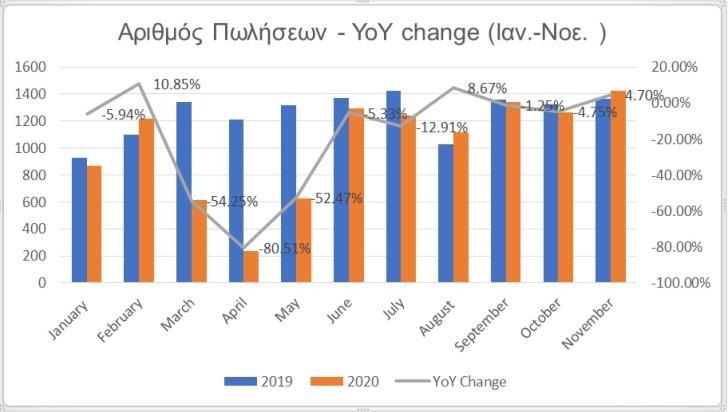
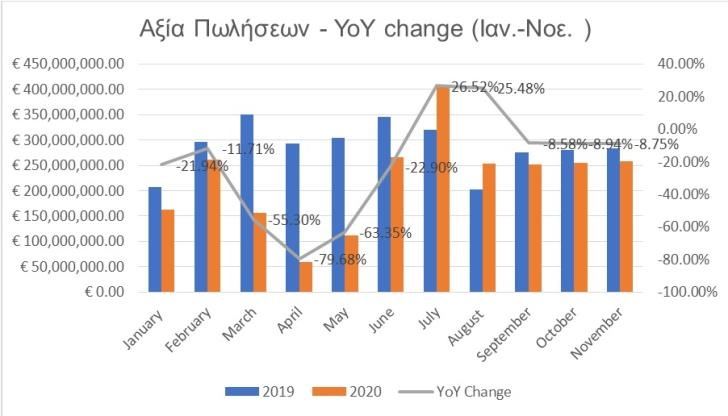
Source: Department of Lands and Surveys
Analysis by ACA Valuations
The market is dominated by Cypriot buyers, who accounted for 81% of all transactions in January – November 2020, followed by buyers from the EU with 12% and non-EU foreigners with 7%. Although the overall picture of the market can at best be described as restrained, the behaviour of foreign buyers is interesting. Transactions by foreign buyers rose by 270.6% overall compared with the same period last year: 2,142 transactions were recorded in the period, against 578 a year earlier. The largest increase came from European buyers (292%, or 1,372 transactions), who make up 64% of sales to foreigners, while non-Europeans rose by about 237.7% to 770 transactions.
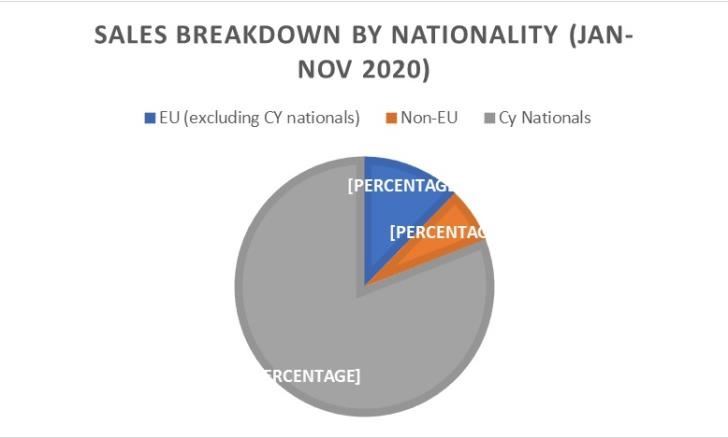
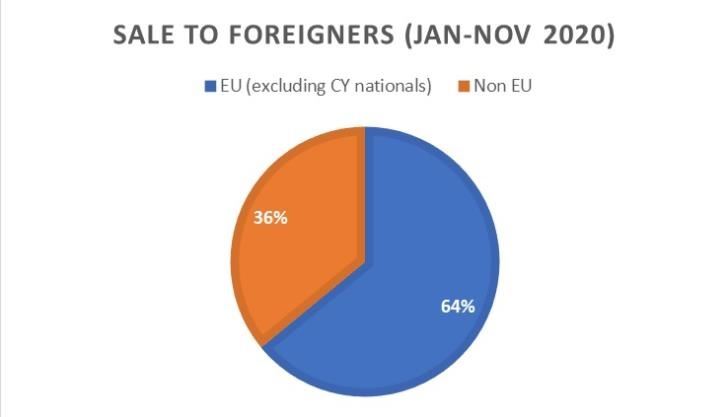
Taking the analysis further, below are the main figures by district for January – November 2020:
Nicosia
The data show that Nicosia was the district least affected by the negative external factors. A total of 3,518 transactions worth about €739.2m were recorded in the period. Compared with the same period last year, transactions fell by 8.4% in volume and 9.8% in value. The largest drop was in April, at −85.4% in volume and −74.4% in value. The strong recovery came in July, when value rose by about 117.7% year on year. Notably, in volume terms the four months August – November were positive, with an average increase of 18% over the same period last year.
More than any other district, Nicosia is dominated by Cypriot buyers, who make up 88% of all sales. They are followed by European buyers with 10% and non-Europeans with the smallest share, 2%. Transactions by foreign buyers in the district rose by 616.7% year on year, with European buyers up 726.5% and non-Europeans up 325%.
Limassol
Limassol appears to have been particularly affected by the downturn, with transactions down 21.2% in volume and 27.7% in value compared with last year. Apart from the first two months, the fall in volume was universal, with the largest, −80.5%, in April. The year-on-year rise in value in July and August, of 26.3% and 36.2% respectively, was not enough to offset the decline.
Limassol is an attractive destination for foreign buyers, who accounted for 17% of all purchases in January – November 2020. Notably, sales to foreign buyers rose by about 307% year on year, to 513 transactions against 126 in the same period last year, split equally between European and non-European buyers.
Larnaca
In this period, transactions fell by 22.6% in volume and 22.5% in value compared with the same period last year. April saw the largest drop, at −76.1% in volume and −72.2% in value. Despite the upward trend in the following months up to November, sales only briefly exceeded last year’s levels and remained negative overall. July was a special case: although volume was down 8.3%, the value of transactions rose by 48%.
Following the trend of recent years, Larnaca remained an attractive destination for foreign buyers in 2020, accounting for 22% of all purchases in January – September. Foreign interest was much higher than in the same period last year, up 523.5% (384.6% for European and 975% for non-European buyers) to 424 transactions in total. European buyers made up 59% with 252 transactions, and non-Europeans 41% with 172.
Famagusta
In the period under review, transactions in Famagusta fell by 50.4% in volume (the largest fall of any district) and 19.1% in value compared with last year. 2020 began with increases in volume of 30% and 15.7% in January and February, although value in those months was slightly lower, at −1.35% and −21.47% respectively. Once again, April recorded the largest annual falls, with volume down 87.3% and value down 95.5%. The year-on-year increase in July – September (45.4% on average) only managed to limit the overall decline for the period.
In terms of foreign buyers’ interest, Famagusta shows a picture similar in percentage terms to the other coastal districts. Foreign buyers represent about 18% with 144 transactions in total, up 453.8% on the same period last year. With 125 purchases, Europeans make up 87%, and non-Europeans the remaining 13% with 19 purchases.
Paphos
A total of 1,998 transactions worth €423.6m were recorded in the period, down 27.5% in volume and 32.5% in value compared with last year. The fall in volume and value was universal throughout the period, especially in April, when it reached −76% in volume and −83.9% in value.
Of all property sales in Paphos, 76% were made by Cypriots, 16% by European citizens and 8% by non-Europeans, the largest share of foreign buyers anywhere in Cyprus. Compared with the same period of 2019, total purchases by foreigners in Paphos rose by 175%, to 803 transactions against 292 last year.
The largest increase came from non-European buyers (177.6%), while European buyers rose by 173.7%. On these figures, European buyers make up 66% of all purchases by foreigners and non-Europeans 34%.
Andreas Ph. Christophorides
Managing Director
ANDREAS CHRISTOPHORIDES AND ASSOCIATES LLC
Property Valuers and Consultants


